

Views: 0 Author: Site Editor Publish Time: 2026-02-27 Origin: Site


A vacuum bed for printing equipment is a critical component in modern industrial printing systems. It ensures that substrates remain flat, stable, and precisely positioned during the printing process. In high-speed and high-precision printing environments, even minor material movement can lead to misalignment, blurred graphics, or production waste.
The vacuum bed solves this problem by using negative pressure generated by a high-pressure blower, allowing printing materials to be firmly adsorbed onto a flat working surface. This article explains its applications, working principle, and key advantages in a clear and focused manner.
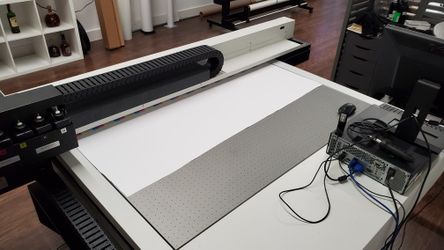
Vacuum beds are widely used across different types of printing systems where material stability directly impacts print quality.
In UV flatbed printing, rigid materials such as acrylic, PVC, glass, wood, and aluminum panels must remain completely flat during operation. The vacuum bed ensures stable adhesion, preventing material lift caused by carriage movement or airflow.
Thin films, membrane switches, and electronic substrates tend to curl or shift under mechanical pressure. A vacuum bed stabilizes these lightweight materials, ensuring accurate ink transfer and repeatable results.
High-resolution inkjet printing requires precise registration. Vacuum beds prevent micro-displacement, guaranteeing sharp image output and consistent alignment.
Fabrics and flexible sheets are prone to wrinkles and movement. The vacuum system evenly distributes suction force, maintaining smooth surface contact during printing.
Across these applications, the vacuum bed plays the same essential role: secure material fixation without mechanical clamping.
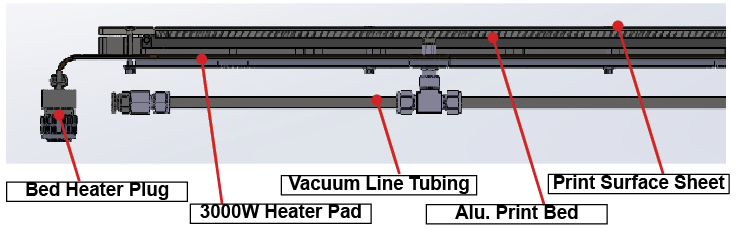
The vacuum bed operates based on a simple physical principle: pressure difference.
A high-pressure blower extracts air from the internal chamber beneath the printing surface. As air is removed:
Internal pressure drops below atmospheric pressure.
A pressure differential is created.
Atmospheric pressure pushes the substrate downward.
The material adheres firmly to the bed surface.
This negative pressure effect generates stable holding force without direct mechanical contact.
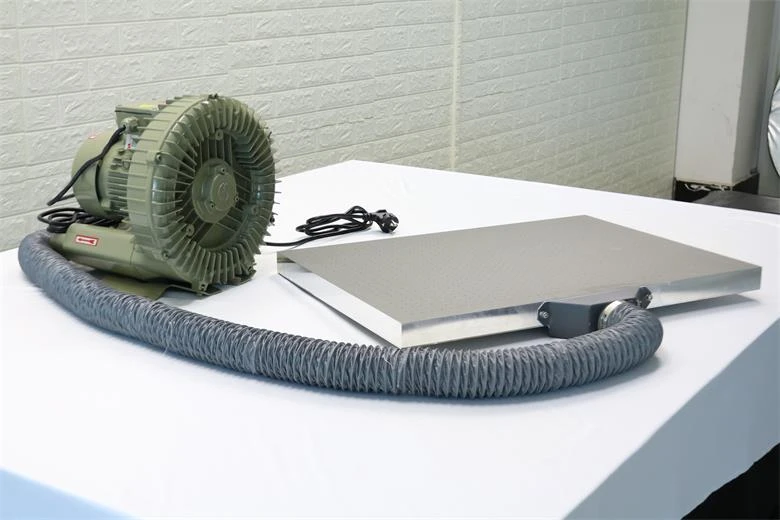
The high-pressure blower is the core driving unit of the system. It continuously evacuates air from the vacuum chamber, maintaining steady suction.
Key characteristics include:
Continuous airflow generation
Oil-free operation
Stable negative pressure output
Low maintenance requirements
Compared to traditional vacuum pumps, high-pressure blowers are more suitable for industrial printing environments due to their reliability and efficiency.
A typical vacuum bed consists of:
A perforated flat surface panel
Internal air distribution channels
A sealed vacuum chamber
Suction zoning control
A high-pressure blower
The top surface contains evenly distributed micro-holes. When suction is activated, air flows through these holes, creating uniform adsorption force across the substrate.
The holding force depends on two factors:
Pressure difference
Surface area
The larger the contact area and the stronger the pressure differential, the greater the holding strength. This ensures stable fixation even for large-format or rigid substrates.
Stable material positioning prevents:
Image misalignment
Double printing
Head collision
Blurred output
This is essential for high-resolution and multi-layer printing processes.
Vacuum fixation eliminates the need for manual clamps. Operators can:
Load materials quickly
Reduce setup time
Increase printing speed
This enhances overall productivity in industrial environments.
Mechanical clamping applies force only at specific points. In contrast, vacuum beds provide even suction across the entire surface, ensuring:
Flat material contact
Reduced deformation
Consistent ink distribution
Vacuum beds support various materials, including:
Plastic sheets
Metal panels
Paperboard
Fabric
Composite boards
Zoned suction control allows adaptation to different sizes and shapes.
Material movement is a primary cause of printing errors. A stable vacuum system significantly reduces scrap rates and rework, improving overall production quality.
To maintain optimal performance:
Ensure proper sealing of unused suction zones
Keep perforation holes clean
Match blower capacity to bed size
Inspect sealing strips regularly
Proper maintenance guarantees consistent suction performance and long service life.
The principle of vacuum bed for printing equipment is based on negative pressure generated by a high-pressure blower. By creating a pressure difference between the vacuum chamber and the external atmosphere, the system firmly holds printing materials onto a flat surface.
Its wide application in UV printing, screen printing, inkjet systems, and textile printing demonstrates its essential role in modern production lines. With improved accuracy, higher efficiency, reduced defects, and broad material compatibility, the vacuum bed has become a standard solution in advanced printing equipment.
For manufacturers seeking stable performance and precise output, vacuum bed technology remains a reliable and effective choice.
